The Rise of Artificial Intelligence and Where We Go Next
Over the last decade, we've seen a technological boom not unlike the one we saw a decade earlier when Apple unveiled the iPhone; only this time, it wasn't just the silicon that was making headlines and leading the way, it was the software as well. With the rise of artificial intelligence came a new era, and the corporate world sprung into action out of necessity and for a competitive edge, truly transforming the world we once knew and understood. As the echoes trickle down, the changes are still riding the waves of that very boom. We are fast approaching our physical boundaries with transistor scaling slowing and energy consumption skyrocketing; researchers the world over are searching for alternatives and answers to problems we didn't have a decade ago.
They are doing this by exploring alternative computation substrates and paradigms.
One name making headlines and paving the way is "Willow," Google's Willow chip. With the advancement of fault-tolerant quantum computation, we have moved well beyond the proof-of-concept and straight into systemic implementation—if nothing else, out of pure necessity, for the plateau we are about to reach is approaching quickly.
As we approach this plateau, the implementation of quantum error correction protocols and superconducting circuit architectures are leading, as demonstrated by Google's AI Willow processor, released Dec. 9, 2024.
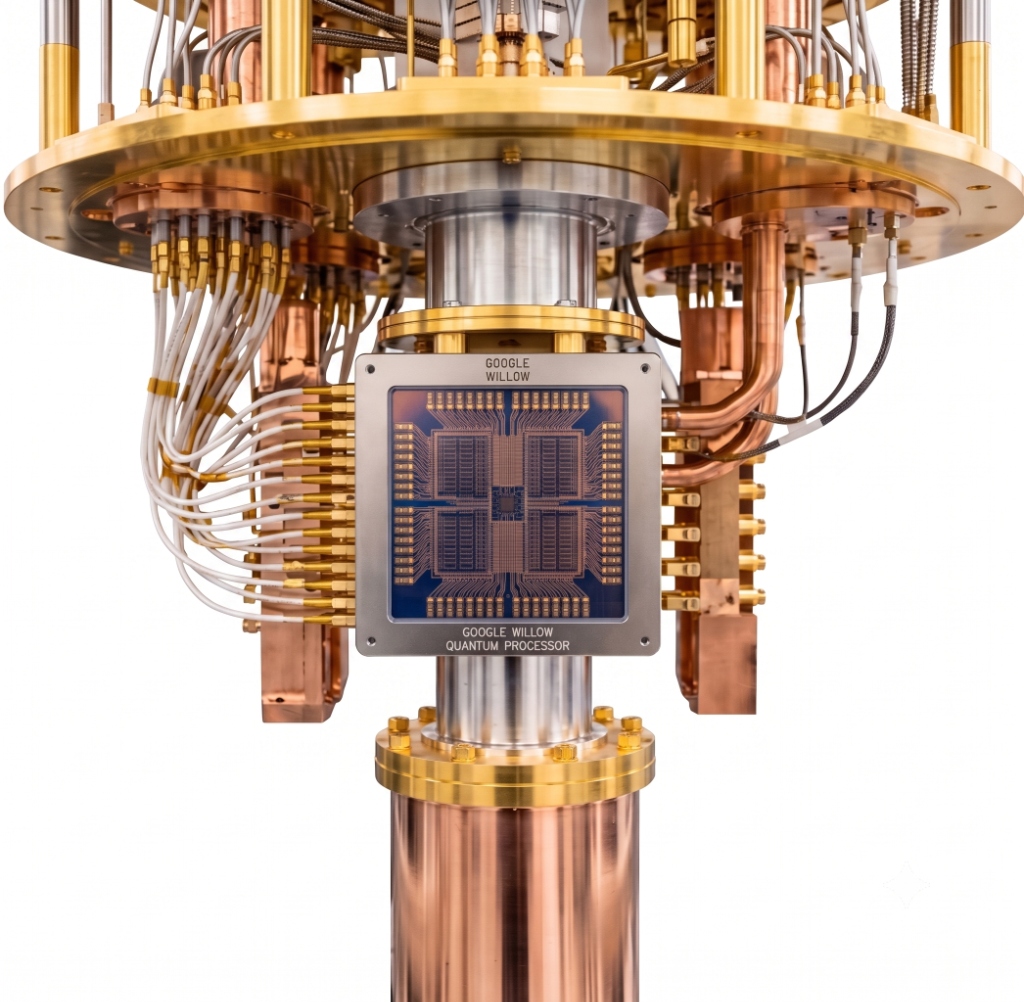
The Willow processor is a 105-qubit superconducting quantum processor constructed using a square grid of superconducting transmon physical qubits. The processor was able to achieve an average qubit connectivity of 3.47, an architectural enhancement over its predecessor, the "53-qubit Sycamore processor." This enhancement was attributed to a list of improvements from fabrication techniques to circuit parameter optimization.
Google's physical design strategy balances the trade-off between electromagnetic shielding and quantum coherence by exploring different layouts and optimizations. Tighter geometry for electromagnetic shielding, maximized coherence times, and structural focus... all part of Google's plan for Willow to target two major computational milestones: exponential error suppression and random circuit sampling superiority.
The performance of this single chip rippled throughout the entire world—not just in the tech industry, but in science as well. Physics and technology aren't always too far apart, generating debates of possible multiverse realities. It's worth noting that in this significant debate lie discrepancies between peer-reviewed literature and popular technology analyses, with Willow being incorrectly dubbed an AI-centric mobile processor designed for smartphones and smart home devices. However, if we take a look at the technical specifications, Willow is strictly designed for cryogenic superconducting; integrating them into consumer products is physically impossible.
To put Willow's performance into context, let's shift our focus for a minute and allow ourselves to look at some of the other players racing to once again raise humanity's plateau.
IBM, a competitor of Google, has taken another approach in design choices, starkly contrasting Google's in what you would expect to see when competition drives innovation, decision-making, and boardroom strategies.
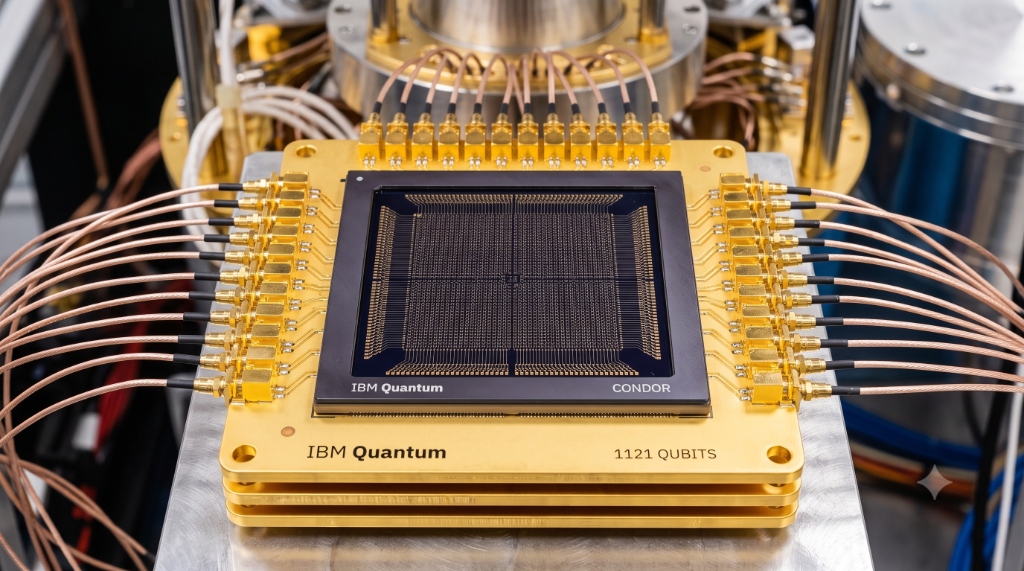
IBM's scaling strategy focuses on a heavy-hexagonal lattice configuration, which minimizes unwanted qubit interactions and crosstalk by limiting each qubit's connection to at most two or three neighbors. Having pulled the curtains back on the Condor processor in Dec. 2023, the Condor processor integrates 1,121 superconducting qubits on a single chip and utilizes advanced 3D packaging to stack control and readout circuitry on different layers from the qubits, thus achieving a 50% increase in qubit density and incorporating over a mile of high-density cryogenic flex I/O wiring inside a single dilution refrigerator.
While Condor serves as a demonstration of large-scale single-chip integration, IBM's performance is structured around the IBM Heron processor family. Heron features 133 to 156 qubits with tunable couplers, delivering a threefold reduction in error rates compared to previous Eagle processors. In 2025, IBM released the Heron r3 revision to mitigate Two-Level System (TLS) defects, alongside the Nighthawk processor, a 120-qubit system on a square grid designed to increase connection density for complex workloads. IBM’s long-term strategy focuses on modular multi-QPU systems connected via conventional electronics or microwave links.
Quantinuum takes a different approach, utilizing a trapped-ion system rather than superconducting circuits. Its System Model H2 quantum computer uses a Quantum Charge-Coupled Device (QCCD) racetrack architecture. In 2024, Quantinuum expanded this system from 32 to 56 fully connected qubits, demonstrating (99.9%) two-qubit gate fidelity across all pairs. By avoiding the physical grid constraints of superconducting chips, the H2 racetrack architecture supports all-to-all connectivity, achieving a record Quantum Volume of $2^{23}$ ($8,388,608$) in May 2025. This all-to-all connectivity enables high logical encoding efficiency, deriving 48 logical qubits from just 98 physical qubits.
These examples are both extraordinary in accomplishment and in scale. To be sure, the timing is not unintentional; the corporate world knows we are losing momentum, if for no other reason than pure physical barriers.
What does this mean to the average person? Well, if you're just a tech enthusiast and hobbyist like myself, not much. If you are working in the tech industry, well, then you know the momentum in which things change in the tech world and the amount of work that comes when they do. If you are an investor, I would hope you have done your homework because the corporate world will not sit still nor sit silent; it's not "if," but "when." The next big thing is around the corner; the only question is whether you will see it coming.
And if you're just an average person sitting at home, you only wait idly to ride the next wave of humanity's march towards technological advancement.