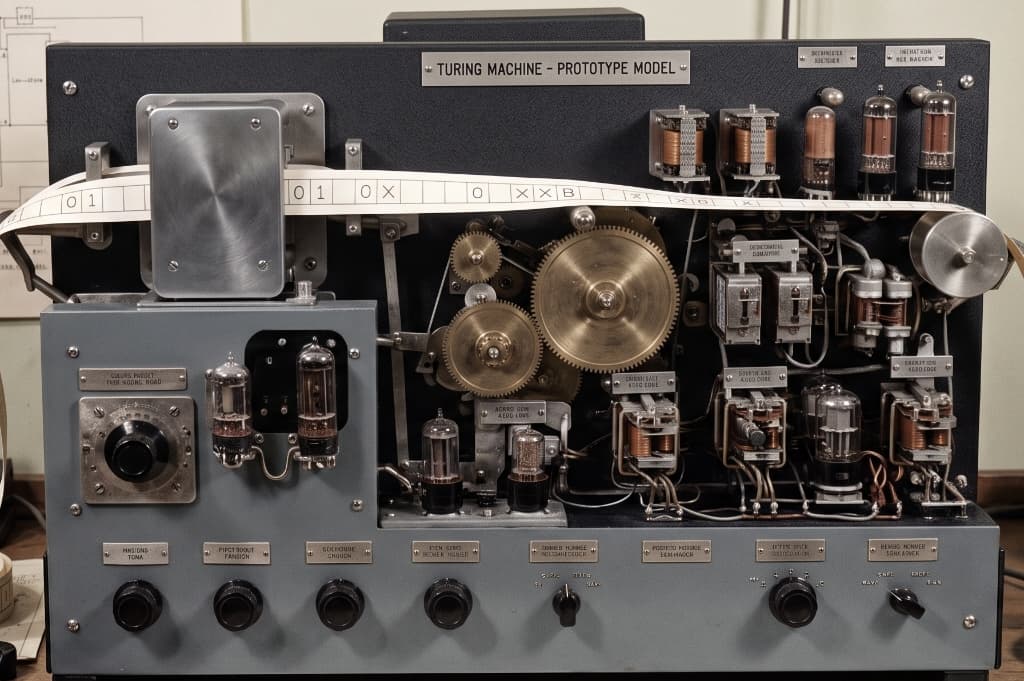
Every modern digital device—from the smartphone in your pocket to the massive neural networks powering modern artificial intelligence—traces its lineage back to a single radical question: Can physical matter think? In the mid-1930s, computers weren't electronic machines; they were human clerks carrying out repetitive, rote calculations. The man who shattered this paradigm and laid the foundation for the digital age was a brilliant but isolated British mathematician and logician named Alan Turing. Here is the story of how a deeply human tragedy, a run through an English meadow, and a series of abstract mathematical equations gave birth to the modern computer.
The Spark
A fellow student who shared his passion for math and science, Christopher Morcom, a childhood friend, taught the naturally chaotic Turing to be methodical and precise. Following the tragedy of Turing's childhood friend passing from bovine tuberculosis in early 1930, the devastated young Turing began a lifelong quest to understand life—specifically, the mind. Mr. Turing turned to quantum mechanics and mathematical logic for answers, diving deeply into mind-body dualism and philosophy. The questions Mr. Turing mused: Is the body merely a physical machine that the mind animates? This profound philosophical view would define the blueprint for modern computing: the body as hardware and the mind as software—an extraordinary concept that still carries weight today.
The Meadow: Abstracting the Mind into Math
By 1935, Turing was a Fellow at King's College, Cambridge, attending advanced lectures on the foundations of mathematics taught by Max Newman. Newman introduced him to David Hilbert's Entscheidungsproblem(the "decision problem"): Was there a "mechanical process"—an algorithm—that could determine whether any given mathematical assertion was provable? Turing worked in complete isolation to solve this riddle. During a long run along the River Cam to the town of Grantchester in the early summer of 1935, he collapsed in a meadow to rest. In that meditative, exhausted state, a flash of intuition struck: he could resolve Hilbert's abstract logical problem by imagining a physical, mechanical version of a human clerk writing on paper. In his landmark 1936 paper, "On Computable Numbers, with an Application to the Entscheidungsproblem," Turing formally introduced what Alonzo Church would later name the Turing Machine.
What is a Turing Machine?
Turing's hypothetical machine was incredibly simple. It consisted of:
An Infinite Tape: A paper tape divided into discrete squares, acting as the machine's memory.
A Read-Write Head: A scanner that could read a symbol from a single square, write a new one, and move one square left or right.
A State Register: An internal tracker representing the machine's current "state of mind."
An Instruction Set: A table of rules dictating what the machine should do based on the symbol it reads and its current state.
Formally, logicians define a Turing machine as a quadruple: T=(Q,Σ,s,δ), where Q is the finite set of states, Σ is the alphabet of symbols on the tape, s is the initial state, and δ is the transition function mapping the machine's behavior: δ:(Q×Σ)→(Σ×{L,R}×Q).
The Master Stroke: Treating Programs as Data
In the 1930s, calculating machines were built to do exactly one thing—like a cash register. If you wanted a machine to do something else, you had to physically rebuild it. In Section 6 of his paper, Turing delivered his ultimate breakthrough: the Universal Turing Machine (UTM). He realized that the instructions (the transition rules) of any specialized Turing machine could be translated into letters and numbers. By converting a machine's behavior into a "Standard Description" and then into a unique "Description Number" (a concept similar to Gödel numbering), Turing showed that a program could be written onto the paper tape as data. The UTM would simply read this "program" from the tape and simulate the target machine's operations. This was the theoretical birth of software and the stored-program computer.
The Halting Problem: Limits of the Code
Turing used this universal model to answer Hilbert's Entscheidungsproblemin the negative—proving that there are some mathematical questions that logic simply cannot resolve. He did this by demonstrating the undecidability of what we now call the Halting Problem. Imagine writing a program designed to analyze any other program and its input to determine a simple yes-or-no question: Will this program eventually finish running, or will it loop forever? Using a proof by contradiction (diagonalization), Turing showed that if such a halting-detector existed, you could construct a second "diagonal" machine that was programmed to do the exact opposite of the detector's prediction. If passed its own code, this diagonal machine would loop if it was predicted to halt, and halt if it was predicted to loop. This logical paradox mathematically proved that a universal halting-decider is impossible. Because the Halting Problem is uncomputable, Turing proved that there is no general, mechanical method to solve all mathematical problems.
From Paper to Silicon: Winning the War and Designing the Future
When World War II broke out in 1939, Turing was recruited to Bletchley Park, the British government's codebreaking headquarters. There, Turing's abstract thinking and hardcoded logic clashed with physical engineering like waves at a shoreline. Mr. Turing kept chewing, coming away with the design of the Bombe machine, a machine that cracked the double-encrypted Enigma machine deployed by the German military. Simultaneously, Mr. Turing's academic work was catching the attention of John von Neumann, a Hungarian-American. Heavily influenced by Turing's "logic machine," von Neumann drafted the logical framework for the EDVAC, establishing the stored-program binary architecture that is still known today as the "von Neumann architecture."
The Final Frontier: AI and Morphogenesis
After the war, Turing continued to push the boundaries of what machines could achieve. In 1950, he published "Computing Machinery and Intelligence," introducing the "Turing Test" (the imitation game) to evaluate whether a machine could successfully mimic human conversation. Long before computers had more than a few kilobytes of memory, Turing was writing about "learning machines" that could adapt and evolve beyond their original programming. His final years were spent merging computation with biology. In 1952, he published a paper on "The Chemical Basis of Morphogenesis," using mathematics to explain how complex physical patterns—like the stripes on a tiger or the growth of an embryo—could arise naturally through chemical reactions. His staggering contributions in wartime and the dawn of technology secure his title as the grandfather of modern computing—the ultimate pioneer who looked at a simple strip of paper tape and saw the entire digital future, from an awkward child to defining the technological future of generations.