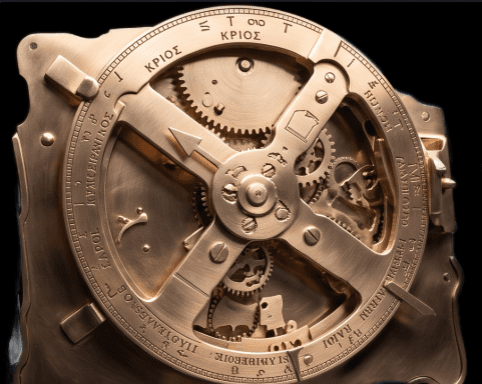
The Antikythera Mechanism: Clockwork, Cosmos, and Mystery
Discovered by sponge divers in 1900 off the Greek island of Antikythera, this fractured and completely fused piece of bronze is the world's oldest known analog computer. Built around 100 BCE, it tracked eclipses, planetary movements, and the cycles of the Olympic Games with a mechanical sophistication that wouldn't be seen again in Europe for another millennium.
As we peer through the historical lens of time, let's take a look at the minds that could have been behind the gears.
History provides no single name credited with inventing the mechanism. Instead, let's capture what we believe to be history and facts and provide a theory.
A theory that provides a solid foundation of the who, what, when, where, how, and why through what we will call a pyramid of sophisticated, interconnected Hellenistic scientific culture. If we trace the intellectual lineage (the knowledge that would be needed) to create this masterpiece, frozen in time by fate, cosmic intervention, or pure dumb luck, we find a network of elite minds:
Archimedes (3rd Century BCE): The pioneer of mechanical automation and celestial spheres.
Apollonius of Perga (3rd–2nd Century BCE): The geometric mastermind who modeled the irregular orbits of the planets.
Hipparchus (2nd Century BCE): The master astronomer whose precise lunar theories likely provided the math for the gears.
Posidonius (1st Century BCE): The philosopher-engineer whose famous workshop on the island of Rhodes kept this high-tech tradition alive.
The shipwreck that left a mystery that wouldn't be unraveled for another 2000 years:
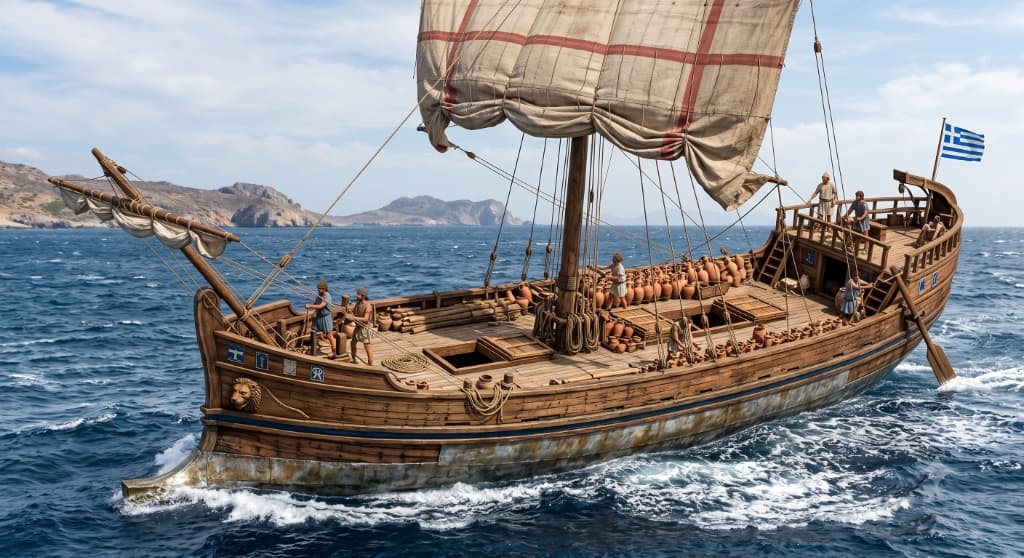
70–60 BCE, it was packed away as luxury cargo aboard a massive Greek merchant freighter. Stretching roughly 165 feet long and powered by a single, towering square sail, the heavy 300-ton ship was loaded with elite goods—fine pottery, marble statues, and this unparalleled scientific masterpiece.
To bring everything into perspective and add food for thought we will use logical deduction and a little psychology(known human behaviors)
to paint a picture of who might have owned the mechanism and where it was bound for before its 2,000-year resting place at the bottom of the Aegean Sea.
1. The Ultra-Wealthy Roman Patrician (The "Flexer")
Probability: 85%
The Context: Late Republican Rome was a hyper-competitive, vanity-driven society. Wealthy aristocrats (think Cicero, Lucullus, or Crassus) were obsessed with Philhellenism—the adoption of Greek culture.
Human Behavior Lens: This mechanism was the ultimate ancient parlor trick. It was housed in a beautiful wooden box with dials and inscriptions. An elite Roman didn't buy this to navigate a ship or do raw science; they bought it to display in the library of their suburban villa. It was a tool for conspicuous consumption—something to crank dynamically at a dinner party to prove to your rivals that you literally held the mechanics of the cosmos in your hand.
2. The Roman General / Political Campaigner (The "Winner")
Probability: 70%
The Context: Rome was systematically looting the Greek East. Generals like Sulla had recently sacked Athens (86 BCE), stripping the region of its treasures to fund their political ambitions back home.
Human Behavior Lens: In Rome, political power required throwing massive public games and building temples to buy the loyalty of the public. A unique, jaw-dropping technological marvel like this mechanism could be dedicated to a temple (like the Temple of Mars Ultor later on) as a monument to Roman dominance over Greek intellect. If it wasn't a personal purchase, it was highly likely destined to be political capital for a high-ranking commander celebrating a triumph.
3. The High-End Luxury Art Broker (The "Middleman")
Probability: 95% (as temporary owner)
The Context: Because the mechanism was packed deep in the cargo hold alongside multi-ton statues, it was treated as commercial freight, not personal baggage.
Human Behavior Lens: There was a massive class of elite Roman fixers (like Cicero's real-life art dealer, Atticus) who went to Greece, bought up entire workshops, and shipped the loot back to Italy to auction off to the highest bidder. To a merchant, the mechanism wasn't a miracle of science—it was a high-margin, unique asset. They knew that whatever wealthy Roman saw it first would pay an astronomical sum just to ensure their neighbor didn't get it.
4. An Astrologer or Scholar (The "Professional")
Probability: 15%
The Context: While the machine tracks the Metonic cycle, eclipses, and the games (like the Olympics), professionals didn't actually need it.
Human Behavior Lens: Real ancient astronomers and astrologers used parchment scrolls, ephemeris charts, and basic mathematics. Those tools were cheap, portable, and easily updated. Spending thousands of hours of master-craftsman labor to forge bespoke bronze gears just to read data you already have on a scroll makes no economic sense for a working scientist. The only way a scholar owned this is if they were a high-society astrologer catering to superstitious Roman politicians who demanded a visual spectacle to justify going to war.
For what it's worth.
If human behavior tells us anything, the mechanism wasn't lost on its way to a university...